  ® ®
|
Rogues' gallery |
|
This is a collection of fallacies from various online sources. This is not about people. There are no names on purpose. It's about forums. The sad part is, the following is just a tiny collection of statements made on forums that evidence astonishingly limited powersports maintenance understanding. I mean, it's really bad advice. Too bad it's typical of what's on powersports user forums. |

|
|
As I always tell CBX owners, if you want your 600-700 pound CBX to perform like a Vespa, then sure, accept that compression. It's a long way from the 170 psi the bike was manufactured with. What a shock you will get if you have that sick engine properly rebuilt. Of course, forums are uniformly "in denial" in regard to where that compression went. |
| Use of a feeler gauge to measure piston-to-cylinder clearance. |
|
This is so bad I don't even know what to say. To begin with, have you ever seen a 0.0007" feeler gauge? How about a 0.0005" or a 0.0003" one? Many vintage Hondas assemble to that spec. |

|
|
How often? How about every 2500-3500 miles as Honda specified for their vintage machines? And really, as often as you touch any tuning aspect of your motorcycle's engine. Common sense, this. |

|
|
Misspelling aside, the U.S. model CBX alternator produces more power than the alternator on the GL1100, the touring bike that was contemporary with it. I don't think 350 watts is something to disregard. And neither is the alternator a bad design. Like anything, it has weak points that knowledgeable people know how to overcome. It's a good system. It's not "crap". |
| Adjust the mixture screw for highest idle then turn the screw in to lean the mixture and obtain a 100 rpm idle speed drop. |
|
Incredible. Do people simply regurgitate what they read somewhere, like a dog excitingly wagging his tail when finding an old bone? The many who champion this special technique are describing Honda's idle drop procedure. What folks all over the Internet, due to a lack of experience in the industry, fail to appreciate is that this is an emissions adjustment, not best practice for tuning your engine. Far from it. But appropriating a technique completely out of its context is what forums do best. |

|
|
No. It's simple leanness. It has nothing to do with slide movement, whose effect is incorrectly stated here anyway. Reduced CV carb slide movement richens, it does't lean. |
| Honing a brake master cylinder. |
|
This is not something you ever want to do to an aluminum master cylinder. Just plain idiotic. |

|
|
No. Use good quality head gaskets. Don't machine the engine parts or fool around with different o-rings. No career mechanic has ever had to do this. |

|
|
Nonsense. The PD series Keihin carburetors are the easiest of all SOHC four carbs to rebuild. And good performers, too. There's a reason dealer mechanics used to use them as upgrades on earlier models. |
|
|
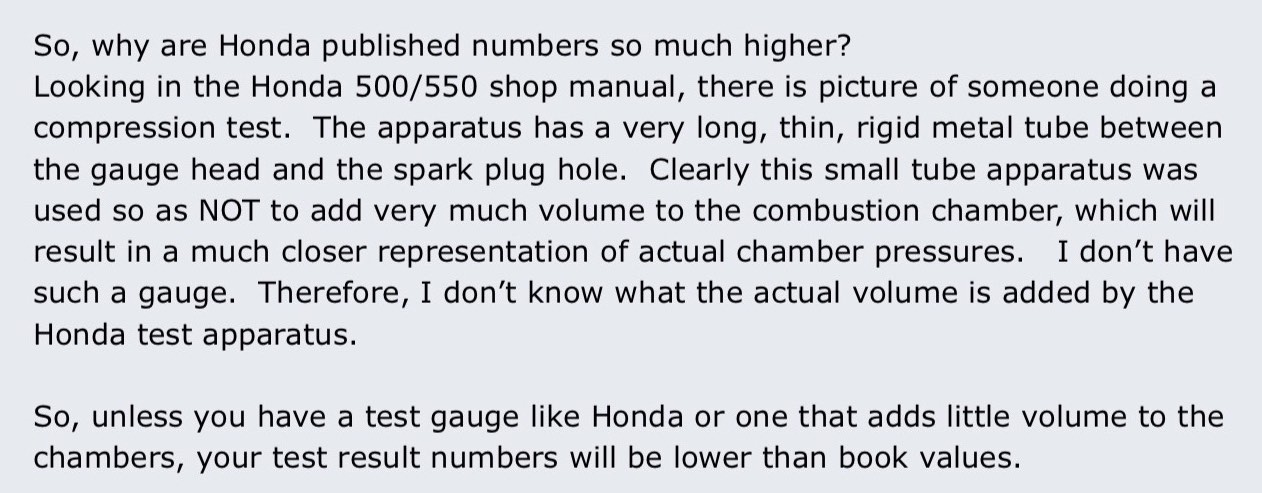
This is so messed up it's hard to know where to begin. Vintage Honda SOHC fours read exactly 170 psi cylinder compression at sea level when they are rebuilt using quality, factory or factory-like parts and professional machining and assembly technique. Not only that, no career mechanic has ever failed to get accurate compression readings indicating the engine's condition, when using a quality tool. But of course we don't use toy tools. |

|
|
There is no good reason to do this. Not because of ethanol, not because of changes to gasoline, and not because Honda made the carbs too lean. None of those things are true. |

|
|
No. The green Dyna coils work fine on the CBX. Of course, no aftermarket coil increases performance on a well-maintained, perfectly-tuned completely stock machine to begin with. But, whatever. Choose 2.2 ohm, 3 ohm, or 5 ohm. It does not make any difference. |
| Many of the most vocal vintage Honda pundits confuse detonation and preignition. |
|
They are very different things. A telling thing, this. It shows something about their knowledge, that it isn't even up to high school shop class level. |

|
|
Ultrasonic machines do not clean through vibration. They clean by cavitation. And they work. |

|
|
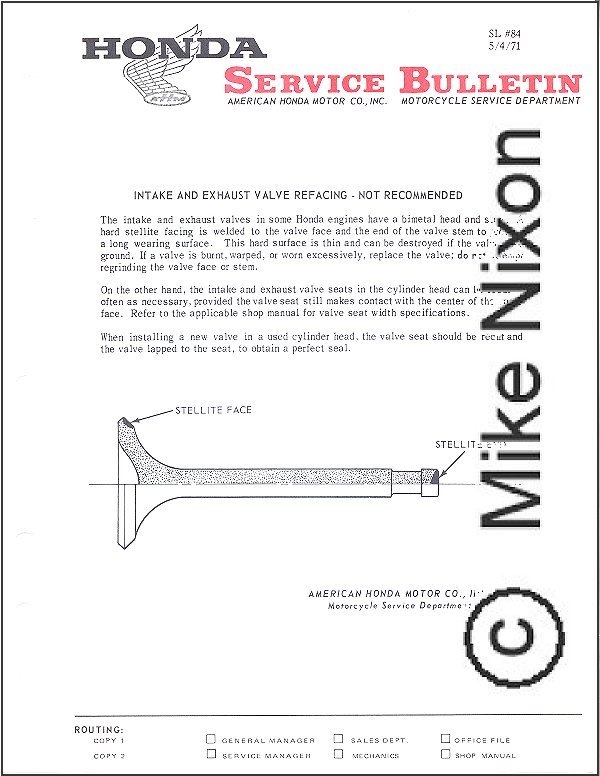
The valves are plated. No stock Honda valve made before the mid 1980s can be refaced. There is a factory Honda bulletin on this. And it has nothing to do with a cam's (not valve's) nitriding, or the procedure known as valve lapping. |

|
|
Whoa, how many fallacies can there be in just one post?! One, the screens were in use way before the CBX existed--on the SOHC 750 for example, and even earlier on the DOHC 450 twin--and on countless models introduced since. Two, the factory Honda screens do not disintegrate. At more than fifty years and counting, virtually all of them are still in use. It's the rebuild kit screens that are junk. |

|
|
Actually, an englarged bore, even a "big bore" (by definition one at least 3mm oversize), due to the resulting compression increase, automatically increases fuel richness. It does not lean the engine. So an increased bore does not by itself necessitate richer carburetor jetting. |
| "Honda does not sell bullet connectors." |
|
Wrong. Honda has sold the male and female bullet connectors from the very beginning and still does. They have communicated it in an unfortunate way however. |

|
|
No. Honda did not make vintage streetbike carburetors too lean. They made them to need maintenance. This proposed leanness is one of the biggest fallacies in powersports. Virtually every performance issue blamed on factory "leanness" is in fact due to lack of maintenance. |

|
|
Nonsense. If I had an SOHC four that didn't charge until 2500 rpm I would get it fixed. Normal breakeven with headlight off is 1300 rpm and only a bit more with the light on. |

|
|
No. Again, if the battery discharges at 3500 rpm the system needs to be troubleshooted and repaired. The sohc4 forum is inexplicalby entrenched in this silliness. |
| Forum "experts" like to promote interference valve angles. |
|
Never a good practice, this has been invalidated since the 1960s. |

|
|
3,000 rpm? No. No. No. Nader? Unbelievably ignorant. |

|
|
Never. Do not abrade your float valve seats! |

|
|
Wrong. Professional mechanics have for generations known that cam bearings can be swapped from one Honda to another with no ill result. Honda themselves has even advocated it. |

|
|
Not so. First, Dyna modules are fairly low quality and nowhere near as good performing as the stock ignition. Second, that said, many many people have run Dynas without the issues opined here. |

|
|
Career mechanics know well that ignition issues can indeed mimic fuel ones, even to the point of coloring the spark plug. It's merely common sense, you don't have to be a career mechanic to know it. One of the jobs of ignition is to keep the plugs clean. |

|
|
Bad advice. Carburetor experts know very well that enlarging the holes does virtually nothing that can be detected in street use. |

|
|
No. Not close to being reality. Even a beginning mechanic knows the issue is air filter restriction, not vacuum signal. Moreover, the CV carb's slide does not move as this post implies. It is not a linear proposition and the slide does not even start to lift until 1/4 to 1/2 throttle. And, less slide movement at the same rpm will result in richness, not leanness, in a CV carburetor. |

|
|
Don't know where this is coming from. Every SOHC four I have serviced for well over fifty years has timed its F mark just fine using both static and dynamic methods. And anyone familiar with these bikes should know what to do should there be a difference. |

|
|
Running your carbs "dry" does not leave them dry, as any mechanic will tell you, and unless Sta-Bil is in the fuel the carbs will varnish up. |

|
|
Lot of error here. First, lead has nothing to do with it. Second, putting oil in your gas is an invitation to detonation. Third, there is no "problem" to solve. And fourth, bronze guides are not an improvement over the long-wearing and self-lubing factory cast iron guides. |
| "The head gasket is impregnated with graphite to allow movement of the head against the cylinder during heating and cooling of the engine without tearing the gasket. It is installed DRY, no sealers." |
|
Bizarre. Simply bizarre. A concept that is unknown to any of my peers in the industry. Not to mention that historically, Honda mechanics have sealed head gaskets, and Honda themselves applied a spray adhesive to most of their head gaskets in the parts wrapper during the sohc fours' era. |
| "The inner output shaft seal is installed with Hondabond." |
|
No. No professional mechanic would ever coat an oil seal with sealer. Presumably the intention is to more securely install the seal, but experience has proved just the opposite happens. The "glued" seal is more likely to squirm out of position than if not glued. Oil seals and o-rings, with very rare exceptions, are not to be "assisted" with sealers. If you have an oil seal working itself out of your engine, either the seal is mismanufactured or your engine is developing excessive crankcase pressure. |
| "...retorque the head." |
|
No. I know of no Honda motorcycle model for which this is necessary or for which Honda has recommended it. And on some vintage Honda four models, it isn't even possible without removing the engine from the frame. |
| "...preliminary measurement with a Vernier caliper indicates they are still serviceable." |
|
First, a caliper is not accurate enough for measuring a Honda piston, a part that is properly fitted in most vintage Hondas at significantly less than 0.001 inch. More importantly, measuring the piston and not also the cylinder tells you absolutely nothing useful about the servicability of either. The correct tack is to measure both and thereby determine wear, most practically speaking, of the cylinder. |
| "The purpose of a bench sync is to get the throttle plates in the same approximate position as a starting point so the engine will run. You still have to do a running synchronization after it's running. Use a soft material so as to not damage the throttle plate or bore." |
|
Definitely not. Anything you stroke under the exquisitely-machined aluminum thottle plate is going to damage it, a part for which there has never been a part number. Thankfully, this urban myth is finally beginning to be understood for what it is. No thinking individual and certainly no professional carburetor rebuilder would ever resort to it. Additionally, though a running sync is always best, very carefully bench-synced carbs installed onto a low-wear and well-maintained engine work famously well. Which is a good thing. It is unreasonable to expect the average rider to acquire the tools or the technique to successfully sync multicylinder carburetors. |

|
|
One, the CB650 does not have CDI ignition. Two, an ignition coil's potential is just that, potential, not what it will ever develop. And three, the vintage sohc CB650 is a really good performing motorcycle. |
| "Carb kits" are still recommended in some quarters. |
|
Do I really have to say anything about this? No one who respects carburetors thinks well of carb kits. Even one or two of the forums have finally caught up to this fact. |
| Removing sync screws when disassembling carburetors. |
|
There is no good reason to do this and several not to. |
| Many "authorities" seem to think the slide spacer rings are for sealing. |
|
That ring is not for sealing. It is for cushioning. It also plays a role in tuning, even in starting the engine. Vacuum sealing on VB series carburetors takes place metal-to-metal. |
| Some sources recommend that the carburetor's primary tube be left alone. |
|
This is a bad idea. While the tube is often difficult to remove, at this late a date best practice for dealing with a stuck tube is well known. |
| Some recommend leaving the pilot screw limiter caps in place. |
|
The limiter caps or covers should have been removed by the dealer decades ago. It is not possible to properly maintain your carburetors with them in place. |
|
As I say, a lot of false information. Here are more articles about forums Issues absent on forums The incestuous nature of forums A comprehensive analysis of forum misinformation |
|
Last updated October 2026 Email me www.motorcycleproject.com My bio © 1996-2026 Mike Nixon |