  ® ®
|
Ignition part 8: The ignition event A fifteen-part series |
Few if any sources on the powersports Internet seem to understand the vintage Honda, Kettering, motorcycle ignition system. Seldom do the terms "rise time", "ionization", "spark duration" or "millisecond" appear in Internet material, even when discussed by individuals claiming electrical training. While a better understanding of the ignition event probably won't improve your troubleshooting skills, it might, and more to the point, it will enlighten you to just what is the nature of this thing we call ignition. The scope trace drawing to the left of the standard Kettering ignition as found on 1970s Honda fours is produced by an ignition scope and displayed in a right angle voltage-versus-time format. The letters aren't of course created by the instrument. They represent important stages in the ignition system's operation. "A" indicates the moment the points open and the ignition coil's primary winding has collapsed. The secondary winding is instantly mutually induced, voltage immediately rises at the spark plug's positive electrode, and when high enough, the plug's air gap is ionized, that is, air's normally insulative property is overcome, and the gap is breached with a spark at "B". The plug's voltage falls dramatically because once started the spark needs less voltage to sustain a spark, giving us zone "C". Note two things. First, that the spark is shown as a tightly wiggling line. This illustrates the slight oscillation in the spark that is responsible for the creation of radio frequency interference (RFI). Resistive components are added to the ignition system to damp this oscillation. Second, note that the spark line ("C") slopes downward, showing that its voltage dissipates. This is as expected. It eventually will drop to a level at which spark can no longer be sustained, at which point spark ceases. Zone "D" illustrates that with plug gap conductivity gone, the load is also gone and the coil's voltage spikes upward momentarily, almost as if it's trying to go to spark level again. But of course it can't, there isn't enough voltage, so it falls precipitously, creating an oscillatiin in the secondary winding that diminishes until there is no more voltage, shown at "F". Soon after, the contact points close, indicated at "G", and there is a tiny oscillation when the primary winding's voltage surges slightly, shown as a tiny negative voltage fluctuation in the secondary. |

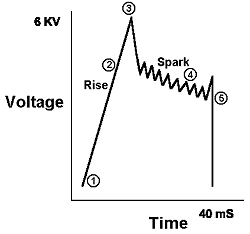
Here is a closeup of zone "C". With time zoomed in on, note that the spark plug's voltage rise time (2) is more clearly depicted. You can see that though at roughly 10-15 milliseconds it is extremely quick by many standards, by electricity's standards it does in fact take a little time. See the "6K" label? No matter how much voltage a coil is rated at, a spark plug fires only at the voltage required to breach the gap. This changes with loads and conditions, but 4,000 to 6,000 volts is agreed to be enough at an engine idle. Note that the ionization and subsequent spark are more clearly represented (3 and 4), including spark's messy, RFI-inducing oscillation and gradual decline. After spark ceases, you can see the uneventful voltage spike (5) and then the complete loss of voltage. While oscilliscope traces such as this haven't proven as useful as we would like in engine diagnostics, particularly in the case of powersports waste spark systems which superimpose two plug firings, one overlayed over the other and thus indistinguishable, these analyses are nonetheless helpful in an educational way. They help us understand how the different ignition systems differ, for one thing. And the mental pictures they form can trigger diagnostic reponses in the real world. |
|
Last updated February 2026 Email me www.motorcycleproject.com My bio © 1996-2026 Mike Nixon |