|
Susceptible to breakage
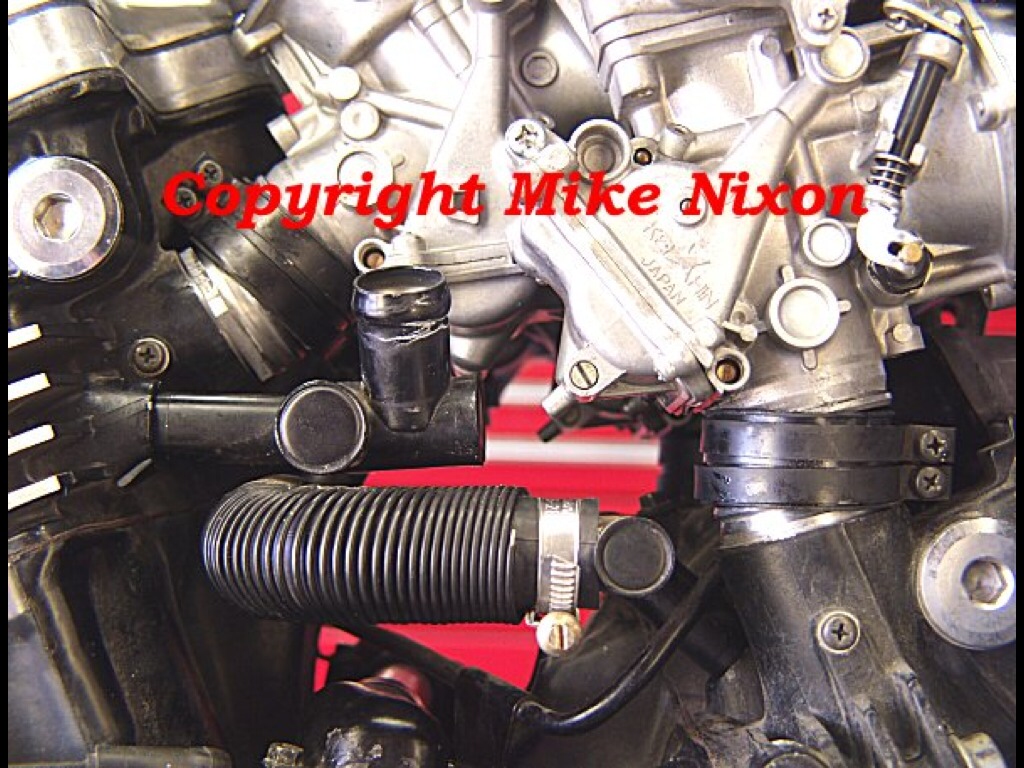
A look at used 1982-1985 first-generation Honda V4 carburetors on ebay will show that a significant percentage of them are broken. I have actually--over the phone--saved carbs from breakage by stopping people from improper removal and install. Install is when they usually get broken. The carbs are so minimalist, so thin-walled and therefore lightweight in construction, that if you apply any force to them when the top plate is loosened or removed, the bodies will break. The top plate is the backbone of the V4 carb assembly. There is no steel bracket ("steady") as on earlier Keihin carbs. The top plate therefore aligns the intricate bodies and linkages, and just as importantly, absorbs all the stresses in any way exerted on the assembly. Because many are not aware of the proper carb-to-engine installation technique, they loosen the top plate's screws in an attempt to wiggle-force the carb body spigots into their manifolds, intending to tighten the screws afterward. This will break the bodies. It will also make everything misaligned: fuel and air pipes and throttle and choke linkages. The correct method is to leave the top plate tightened as it came from the carb rebuilder, and to install the rubber manifolds loose and angled onto the cylinder heads. As the complete carb assembly is eased straight down then, it will engage the manifolds which will at the same time straighten and self-align to the carbs' spigots as the assembly is pushed all the way home.
|
|
This is the correct way to install V4 carburetors back onto the engine. Don't loosen or remove any parts. Note the angles of the manifolds.
|
Plastic fuel pipes
The other thing frequently observed is broken plastic fuel pipes. For the same reason, unprofessional handling of the carbs during removal, bench assembly, or reinstallation. There are a number of aluminum fuel pipe replacements available, but the original plastic pipes aren't a problem when the carbs are properly handled. These carbs are a little like Rubik's Cubes, with nesting and overlapping parts, and nearly every part performing more than one function characterizing their design. Thus more than usual concentration and observation is needed to keep from damaging them.
Synchronization
It is rare to find one of these carb sets even close to good throttle synchronization. The syncing method is unintuitive and unlike any other Honda carburetor. I'm sure that the happy outcomes reported by my V4 carb customers are far less due to the rebuild than due to the careful, knowledgeable bench sync I give the carburetors. Most of these carbs have never got a good sync.
Unfamiliar parts
Every so often I see or hear of V4 carburetors whose owners are attempting to remove unremovable parts. I understand not everyone who works on these carbs knows what all of their parts do, but at this level of immersion an effort to become somewhat knowledgeable should be undertaken. I sympathize, I really do. But it's the same with tinkering with your home computer's operating system. That deep in, you need to be more than a newbie. And the disdain you are likely to get on computer forums is reasonable. V4 carbs (first-gen are VD series) are all downdraft type. Consequently, the jet needle is not perpendicular to the intake manifold. It needs somewhere to go and that somewhere is a special tube manufactured into the carb body. It is permanently attached and not a rebuildable part. The air bleed pipes are also. The choke jet (technically, enrichener jet) is yet another non-removable part. Have a care.
It may not be the carburetor
First-gen Honda V4s come with another very important glitch. Cam timing is very unusual and almost guaranteed to have been done wrong by a previous mechanic. Honda knew their dealers were confused and advanced some interesting felt pen based methodology in factory Honda school. The fact is, if even one of the four cams is a tooth off, the engine will run fine. It will idle and do all the right things. Until it gets to operating temperature, at which point the idle will become frustratingly unstable. Raise a sluggish idle and it hangs, lower a hanging idle and it stalls. There is no fixing it until the cams are timed right. See my V4 page for more. And go here for more on first-gen V4 cam timing.
Part 22
|

 ®
®