  ® ®
|
Little-known anomalies of the Honda GL1000 ignition. |
|
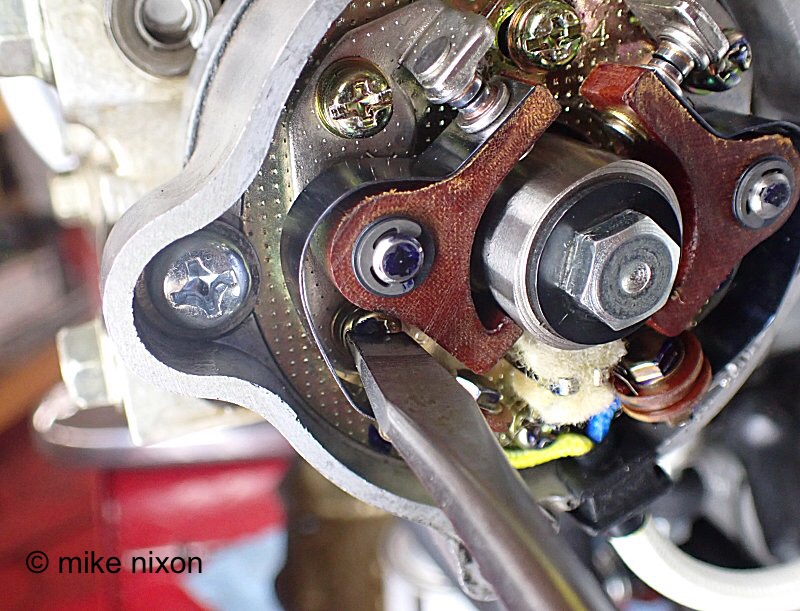
• The GL1000 ignition is driven by a toothed rubber belt. This means its timing is dependent on good belt maintenance, i.e. tensioning, which many people seem to overlook. Sloppiness here results in sloppiness at the ignition. The belt must be carefully tensioned first thing in any tuning scenario. And that means something very different than simply loosening the lockbolt and letting the spring do its thing. • While the belt drives the cam, at the same time the engine’s valve springs oppose that drive, in a way that produces intermittent pulses. The result is no matter how well the rubber belt is tensioned, every 360 degree rotation of the crankshaft (180 degrees rotation of the camshaft) applies varying valve spring forces to the cam and belt arrangement, resulting in slight changes in cam timing, thus changes in ignition timing. • This is further aggravated by a very loose fit (more than 0.005") of the camshaft in its bearings that allows the cam to rock in response to valve spring and drive belt forces, and the ignition along with it. • The ignition is mounted on a snout made into the left camshaft. Sometimes this projection is not straight. It can exhibit some 0.003” indicated runnout. • The points backing plate is a fairly loose fit in the left cylinder head casting. Each time it is rotated to effect a timing adjustment, the plate moves laterally as well as rotationally. The lateral movement changes the carefully adjusted point gap, which in turn also changes the timing. A situation very much like the 70s SOHC inline four. • Although the original Hitachi and TEC branded points assemblies were very high quality, aftermarket substitutes are crappy, resulting in reduced precision, reliability and durability. • The backsides of these inferior points are not flat, so that when their screws are tightened, gap and timing both change. • The screws on the points plate look like Phillips, but they're not. It’s best to use only a flat blade screwdriver on these Taiwanese-spec screws. Using a Phillips screwdriver will tear up their heads. • Many of these problems would be relatively minor if not for the GL1000’s waste spark ignition system. Though a good system, waste spark ignition means that the advance mechanism’s two lobes alternately operate the same points set. The result is timing that is significantly different each time one lobe passes the same set of points versus the other lobe. Every 360 crankshaft degrees, the timing is unique and can virtually never be identical. Essentially, the ignition wobbles. • Any one of these glitches would produce what the industry calls a “ghost” effect when strobe timing the ignition, and all of them together make it a sure thing. For this reason, strobe timing is not the preferred timing method, and even the official manual communicates this. Though it addresses both methods, it gives a lot more focus to the static method. Painstaking static timing is mandatory as it is the only way the wobbling timing can be visualized addressed. Conversations with the factory back in the 70s confirmed their acceptance of this approach long before Wing World magazine's (June 1985) treatment and others' endorsement of it. • Finally, fitting a Dyna or other electronic ignition, while a good alternative up to a point, does not do away with all of these issues and in many cases introduces new ones. |
|
More like this: The GL1000 problem GL1000 facts |
|
How-to booklet: Timing the GL1000 Ignition |
|
Last updated March 2026 Email me www.motorcycleproject.com My bio © 1996-2026 Mike Nixon |