|
There aeems to be some confusion on the 'net, despite this subject being long documented. It's possible I was the first to publicly address it (all the initial mentions on vintage Honda forums are mine), but Honda actually introduced the procedure in a racing service bulletin for their (1980s-era) 900F based road racing engine kits. So the procedure, namely, defeating the factory Keihin carburetor air cutoff system, is at least that old, and is factory-sanctioned.
What does it do?
The aircut valve's job is to momentarily block the air side of the idle circuit (its air bleed, in other words) on deceleration. This makes conditions for exhaust afterburn ("pop") on decel less likely. The aircut system is actually integral to the idle circuit, thus the most complex circuit in any 70s-80s Keihin carburetor. The idle--and therefor the aircut--system has several openings. These include the fuel passage, the air passage ("bleed") that mixes air into the fuel passage, the discharge outlet inside the carburetor bore, the pilot screw cavity, and the three "bypass" ports immediately under the throttle plate. Yup, seven openings, more than any other carburetor circuit, and all of them connected to just the one idle jet. The aircut valve is planted across one of these openings, namely the air bleed passage, before that passage terminates at atmosphere. You can see then that the aircut valve is actually an air blocking device. At the right time (triggered by the closed throttle's extreme vacuum), it shuts off the idle circuit's air bleed. This results in momentary extreme richness. This richness makes the air/fuel mixture enter the combustion chamber burnable thus not go into the exhaust unburned where after mixing with other exhaust gases it would normally combust. Pop! That's all the valve does, momentarily richen the idle circuit on decel to eliminate the pop, the afterburn. Although some call that "backfire" career mechanics know that is not an accurate term.
Why defeat it?
What's the benefit? The benefit is simply to avoid this delicate, oft-failing valve from being a future maintenance concern. Not to mention cost. A GL1100 or 70s-80s DOHC inline four carburetor rebuild can cost $150 in just aircut diaphragms. Defeating the aircut is preemptive maintenance only. There is no performance advantage. Defeating the aircut does not solve any problems. The procedure does not change mixture strength in the idle circuit, or any other circuit. It also does not require compensation elsewhere in the carburetor, despite forum narrative. Because, irrespective of air cutoff defeat, on Keihin VB series carburetors, the real-world-correct pilot screw setting is 2 1/2 turns, and on PD and VD series, 3 full turns, as confirmed both by career experience as well as exhaust gas analyzer readings. Yes, different from what Honda says, but at these settings the throttle response is worlds better and the carbon monoxide level is still under the limits in effect during the time period. And don't miss this point: Far from an adjustment required after air cutoff valve defeat, this should have been done before the bike was even first sold by the dealer, or shortly after. The two things are connected, but not in the way most people think.
Carburetor cleaning
Because the air cut valve is an integral part of the idle circuit, spraying any carburetor cleaning chemical into the such a carb's idle passage while the air cut valve is still in place will destroy the air cut diaphragm, turning it into pudding. The diaphragm must be removed for even the simplest carburetor cleaning. One more reason to defeat it. I see chemically-damaged air cut diaphragms often.
Defeating the valve
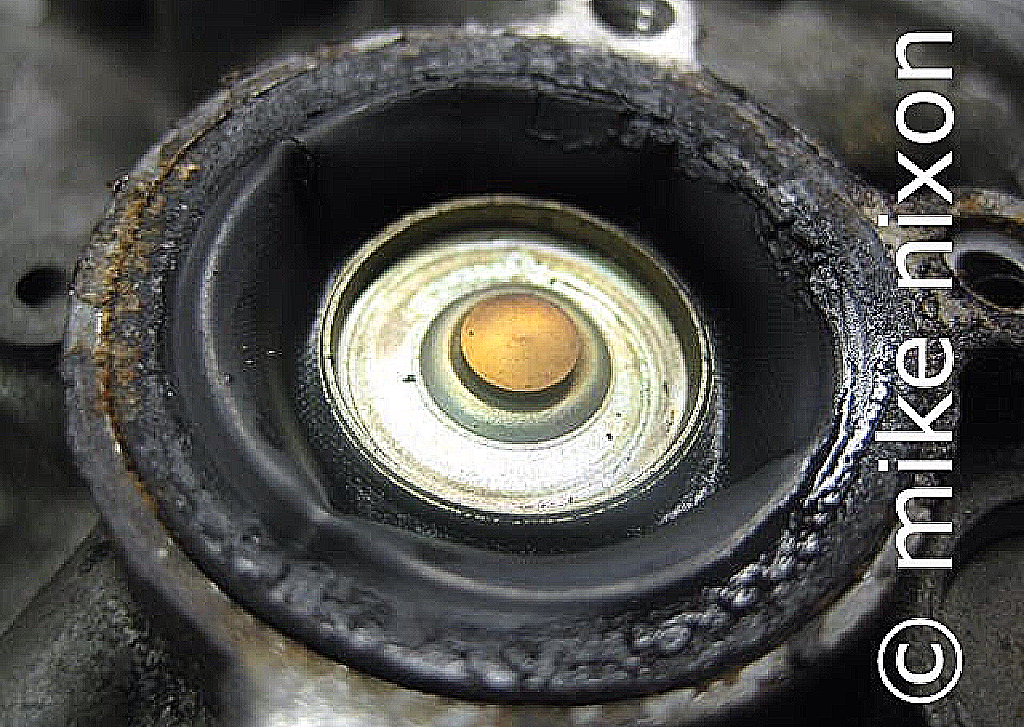
Bypassing the system is as simple as blocking off the vacuum source, the valve's trigger. Do this by substituting a solid piece of rubber in place of the tiny d-ring at the vacuum port. Leave the diaphragm in place even if failed, as in all cases it serves as a gasket for the aircut valve cover, and in some cases is also needed to keep the aircut valve open. Did you notice the difference here? Keihin carbs have two kinds of aircut valves. The two types are piston-valve and trap door. U.S. model 70s-80s DOHC fours, the CX500, CX500, GL1100, and a few others, are all piston valve type. The other type, the trapdoor, found on the CBX, GL1000, GL1200, CB1000C and CB1100F, requires the diaphragm be left in place to prop the trapdoor in its passive, open state.
Caution
If like many you have an aftermarket exhaust on your bike you may not want to defeat the air cutoff valve. It might be best to keep it stock. This is because most non-original exhaust configurations have poor sealing at their many connection points. Outside air can get in at these places and guess what, you have that afterburn thing going on again. If your bike has a non-stock exhaust, consider resigning yourself to putting up with regular air cut valve replacement. That's the price you pay for having an aftermarket exhaust.
|

 ®
®