  ® ®
|
Building and using a cylinder leakdown tester |
|
Everyone remembers how to do a compression test: Screw in the tester, flip the kill switch to "off", hold the throttle wide open, and press the starter button. The cylinder takes in air
and compresses it, and the tester traps it. The maximum is reached when the gauge holds the most pressure the engine can produce. Not too difficult. The weakness of this test however is that a compression test checks too many engine components at the same time--you don't know whether the problem is the cylinder or the valves. A leakdown test tells us which it is, and for that reason is often the followup test after a compression test. Air is pumped into the cylinder from an outside source, and the gauge reads the percentage that escapes. This pinpoints the source of the compression loss.
A real life example
Leakdown testers are cool. Not only does the amount of air escaping from the cylinder register on the gauge, it can also be heard, enabling the source of the leak to be pinpointed prior to the engine teardown. For example, high readings accompanied by hissing in the carburetor indicate burnt, tight, or carboned-up intake valves. The same thing in a muffler points toward--you guessed it--exhaust valves. A breeze coming out of the dipstick hole indicates cylinder wear or worn or heat-softened rings. And, air escaping from an adjacent spark plug hole pinpoints a blown head gasket.
Of course you need an air compressor to use a cylinder leakdown tester. And, you need to now how to accurately find TDCC (top dead center on the compression stroke) for each cylinder that is tested. But if you can correctly adjust your valves, you can use a leakdown tester.
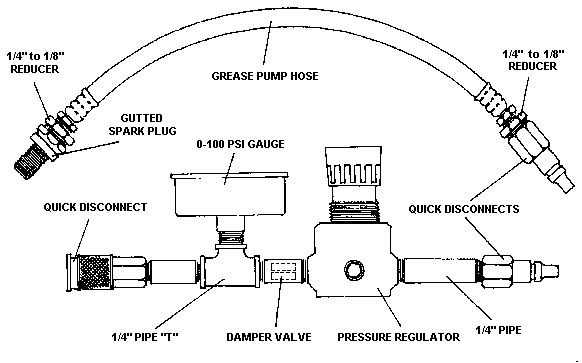
Inexpensive, ready-made leakdown testers are easy to find today. If you're not into making things, or don't have the time, you can buy a leakdown tester for less than $100 at many auto parts stores and the like. But it's also easy to make your own, and it will be a lot more accurate than many of those for sale. |
| Pressure regulator |
This is designed to be screwed onto an automotive paint spray gun. As of this writing in the 1990s, Grainger's was the cheapest. The gauge that is often attached is, unfortunately, the wrong kind for our purposes. We need a lower pressure one. Also, make sure the regulator comes with the block-off plugs for the two passages that you won't be using. |
| Pressure gauge |
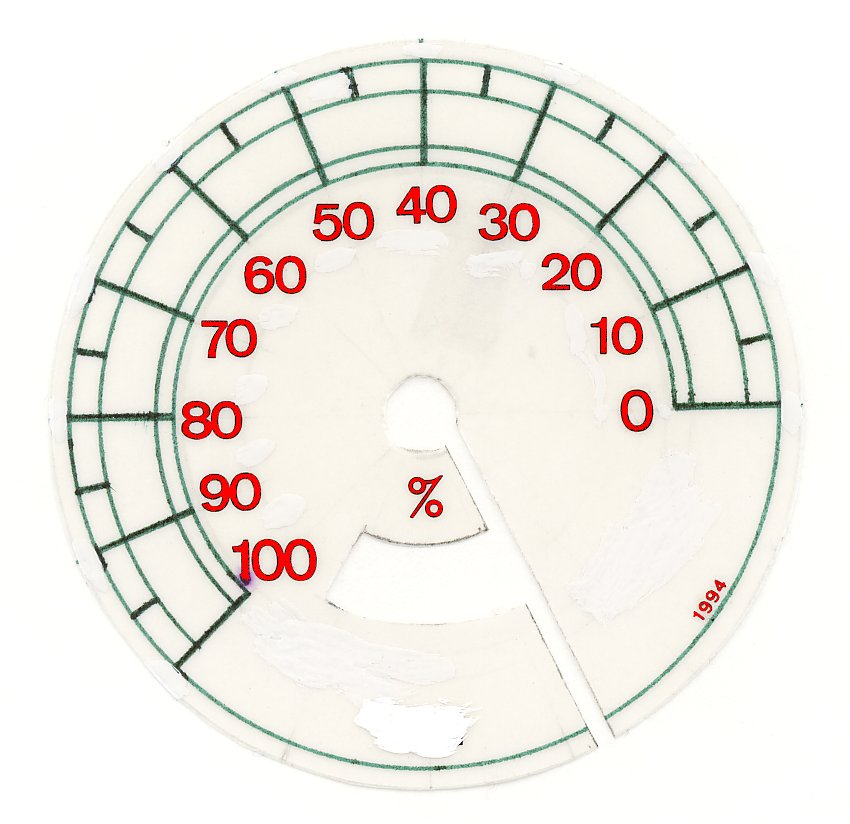
Get a quality, back-mount, 0-60 psi gauge (I know, the picture shows a 0-100, but a 0-60 is more accurate). For the professional touch, carefully pry off the bezel and cover the faceplate with a copy of the label shown below. |
| Spark plug adapter |
Make this by clamping an old spark plug in a vise (protected with wood or aluminum stock, of course, and on the hex--not the threads) and whacking off the porcelain with a well-aimed lateral hammer blow. Then grind off the rolled-over seal above the hex, grind off the ground electrode, put the plug back in the vise and drive out the remaining porcelain with a drift (if difficult, the rolled seam hasn't been sufficiently removed). Tap the hex end with a 1/4" pipe tap (NGKs are hardest to tap but seal the best afterward). Screw the bugger onto a 1/4" to 1/8" pipe reducer, and that onto a 12" grease gun hose (about $5 at Wal Mart and just about anywhere). Or simply buy a compression tester hose at any of several sources. It's the same hose, only without the internal Schrader valve. |
| Damper valve |
This essential part is merely a restriction between the regulator and the gauge. The easiest way to make it is to plug the middle pipe with epoxy and afterward drill a 0.040" (#60 or 1mm drill) hole. I have also simply made an aluminum plug to a tight fit and drilled that. |
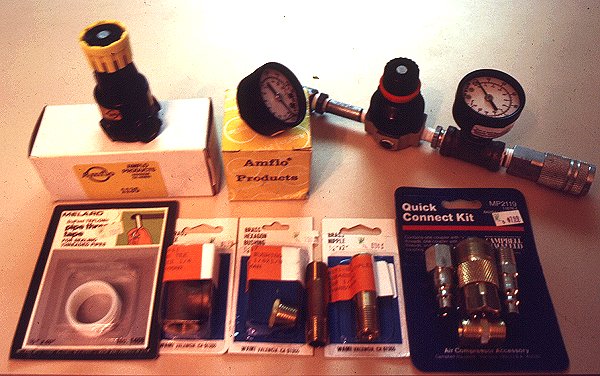
|
To use this tool, put the cylinder to be tested to TDC compression. Plug your tester into an air compressor line and "zero" the gauge. Screw the hose into the spark plug hole. Then connect the two. If the crankshaft turns or you hear all the compressor's air rushing out of an obviously open valve, the cylinder wasn't set exactly on TDC compression. Or you are testing a single cylinder engine, most of which don't have enough internal friction for the piston to stay put and will need a wrench on the crankshaft during testing. Try again. When you get it right, the piston will stay put and the tool will indicate the amount of air that is escaping from around the rings, valves and head gasket of that cylinder. All cylinders leak a little. Large ones leak more, smaller ones less. Production multicylinder engines in good condition leak 3 to 5 percent. Even with 60,000 miles a well-kept engine can still be under 5 percent. But more than 10% leakdown indicates wear that will affect engine performance. Depending on the engine (cylinder diameter, age, how the bike is used, etc.) and your budget, more than 10 percent indicates wear, and into the 20 percent range prompts a rebuild. Cylinders more than 100mm in diameter tend to have a bit more leakdown.
As already mentioned, if the engine you're testing is a big bore single or a twin, there won't be enough friction in the engine to resist the compressed air, even at exact TDC. You have to find a way to hold the crankshaft at TDC compression. Twins and up usually are no problem.
In the event of a high leakdown reading, first take the time to double-check that you are in fact at TDC on the compression stroke, not on the exhaust stroke (where both valves will be open). If that checks out, and the leak is (as it is usually) a valve, make none of the valve clearances is tighter than spec. If that isn't the problem, then remove with a hammer and drift, carefully tap on the valve followers for any bad cylinders, watching the gauge as you do so. This will often loosen carbon from around the valve and the reading will drop to a reasonable level. If that works, you should do a "water clean" on the engine. If not, plan on the rebuild.
One more thing. I mentioned that some leakdown testers may give false readings. I often hear from folks that say their leakdown test results are just 1-2%. No. That is not realistic unless you are a veteran, Nascar-level engine builder. The most common reason for erronious readings is too much air compressor pressure or mistakenly putting oil in the cylinder, or just a wonky tool. Keep it under 80 psi and preferably no more than 60, and do not add oil, for the most accuracy.
|
|
Parts List
|
|
|
Last updated June 2026 Email me www.motorcycleproject.com My bio © 1996-2026 Mike Nixon |